Fun facts about rivers
Fascinating facts about the world's longest and most storied rivers.

The São Francisco River is named for Saint Francis of Assisi, discovered by Europeans on his feast day.
São Francisco
Brazil
The São Francisco River, known in English as the San Francisco River, is a large river in Brazil. With a length of 2,914 kilometres (1,811 mi), it is the longest river that runs entirely in Brazilian territory, and the fourth longest in South America and overall in Brazil.
From the “Names” section
Text from Wikipedia, CC BY-SA 4.0.
Photo: Cleferson Comarela · CC BY-SA 3.0

The name Rhine is derived from the Gaulish name Rēnos, which was adapted in Roman-era geography as Latin Rhenus.
Rhine
Multiple
The Rhine is one of the major rivers of Europe. The river begins in the Swiss canton of Graubünden in the southeastern Swiss Alps. It forms part of the Swiss–Liechtenstein border, then part of the Swiss–Austrian border. From Lake Constance downstream, it forms part of the Swiss–German border.
From the “Name” section
Text from Wikipedia, CC BY-SA 4.0.
Photo: Lucazzitto · CC BY-SA 3.0

The Senegal River has a drainage basin of 270,000 km².
Senegal River
Multiple
The Senegal River ; Wolof: Dexug Senegaal, Arabic: نهر السنغال, romanized: Nahr as-Siniġāl, Hassaniyya pronunciation: [nahrˤ əs.säjnigaːl], French: Fleuve Sénégal) is a 1086-kilometre-long (675 mi) river in West Africa; much of its length marks part of the border between Senegal and Mauritania.
From the “Geography” section
Text from Wikipedia, CC BY-SA 4.0.
Photo: WILLAV-FR · CC BY-SA 4.0

The Euphrates is called Yeprat in Armenian and Fırat in Turkish.
Euphrates
Multiple
The Euphrates is the longest and one of the most historically important rivers of West Asia. Together with the Tigris, it is one of the two defining rivers of Mesopotamia.
From the “Etymology” section
Text from Wikipedia, CC BY-SA 4.0.
Photo: Carole Raddato from Frankfurt, Germany · CC BY-SA 2.0

Parts of the Senqu River freeze in winter because of the high altitude.
Orange River
Multiple
The Orange River is a river in Southern Africa. It is the longest river in South Africa. With a total length of 2,432 km (1,511 mi), the Orange River Basin extends from Lesotho into South Africa and Namibia to the north.
From the “Course” section
Text from Wikipedia, CC BY-SA 4.0.
Photo: paffy · CC BY-SA 2.0

The Zambezi River rises in a black, marshy dambo in dense, undulating miombo woodland at about 1,524 metres above sea level.
Zambezi
Multiple
The Zambezi is the fourth-longest river in Africa, the longest east-flowing river in Africa and the largest flowing into the Indian Ocean from Africa. Its drainage basin covers 1,390,000 km2 (540,000 mi2), slightly less than half of the Nile's.
From the “Course” section
Text from Wikipedia, CC BY-SA 4.0.
Photo: Brian McMorrow · CC BY-SA 2.5

The name Amur may come from the Evenki word for 'river' or the Dagur word for 'big river'.
Amur
Multiple
The Amur River or Heilong River is a perennial river in Northeast Asia, forming the natural border between the Russian Far East and Northeast China. The Amur proper is 2,824 km (1,755 mi) long, and has a drainage basin of 1,855,000 km2 (716,000 mi2).
From the “Name” section
Text from Wikipedia, CC BY-SA 4.0.
Photo: Original uploader was Refrain at zh.wikipedia · CC BY-SA 3.0

The English word 'Nile' is derived from the Latin 'Nilus' and the Ancient Greek 'Νεῖλος' (Neilos).
Nile
Multiple
The Nile is a major north-flowing river in northeast Africa which empties into the Mediterranean Sea. At 7,088 kilometers (4,404 mi) long, it is the longest river in the world, although the volume of water it carries is much smaller than other major rivers such as the Amazon or the Congo.
From the “Names and etymology” section
Text from Wikipedia, CC BY-SA 4.0.
Photo: Valerian Guillot from Cambridge, United Kingdom · CC BY 2.0

The Yellow River was referred to as 'the river' when it was still somewhat clear.
Yellow River
China
The Yellow River, also known as Huanghe, is the second-longest river in China and the sixth-longest river system on Earth, with an estimated length of 5,464 km (3,395 mi) and a drainage basin of 795,000 km2 (307,000 sq mi).
From the “Etymology” section
Text from Wikipedia, CC BY-SA 4.0.
Photo: fading · CC BY-SA 3.0

The Brahmaputra River is known by various names in different regional languages, including Brôhmôputrô in Assamese and Yarlung Tsangpo in Tibetan.
Brahmaputra
Multiple
The Brahmaputra is a trans-boundary river which flows through Southwestern China, Northeastern India, and Bangladesh. It is known as the Brahmaputra in Assam, Yarlung Tsangpo in Tibetan, the Siang/Dihang River in the Mishmi language, and Jamuna River in Bangladesh.
From the “Names” section
Text from Wikipedia, CC BY-SA 4.0.
Photo: Ishanjyotibora · CC0

The internationally known name of the river is based on the Russian name Obʹ, possibly from Proto-Indo-Iranian *Hā́p- ('river, water').
Ob-Irtysh
Multiple
The Ob is a major river in Russia. It is in western Siberia, and with its tributary the Irtysh forms the world's seventh-longest river system, at 5,410 kilometres (3,360 mi). The Ob forms at the confluence of the Biya and Katun which have their origins in the Altai Mountains.
From the “Names” section
Text from Wikipedia, CC BY-SA 4.0.
Photo: Dmitry Karyshev · CC BY 2.0

The Mekong was originally called Mae Nam Khong, meaning 'Mother of Water[s]'.
Mekong
Multiple
The Mekong or Mekong River is a transboundary river in East Asia and Southeast Asia. It is the world's twelfth-longest river and the third-longest in Asia with an estimated length of 4,909 km (3,050 mi) and a drainage area of 795,000 km2 (307,000 sq mi), discharging 475 km3 (114 cu mi) of water annually.
From the “Names” section
Text from Wikipedia, CC BY-SA 4.0.
Photo: Bjørn Christian Tørrissen · CC BY-SA 4.0

The Russian name Volga derives from Proto-Slavic *vòlga, meaning 'wetness' or 'moisture'.
Volga
Russia
The Volga is the longest river in Europe and the longest endorheic basin river in the world. Situated in Russia, it flows through Central Russia to Southern Russia and into the Caspian Sea. The Volga has a length of 3,531 km (2,194 mi), and a catchment area of 1,360,000 km2 (530,000 sq mi).
From the “Name” section
Text from Wikipedia, CC BY-SA 4.0.
Photo: Alexxx1979 · CC BY-SA 4.0

The name Don derives from the Avestan and Rigveda word dānu.
Don River
Russia
The Don is the fifth-longest river in Europe. Flowing from Central Russia to the Sea of Azov in Southern Russia, it is one of Russia's largest rivers and played an important role for traders from the Byzantine Empire.
From the “History” section
Text from Wikipedia, CC BY-SA 4.0.
Photo: High Contrast · CC BY-SA 2.0 de

The first written mention of the Yenisei River dates back to the 7th century in Tang dynasty China.
Yenisei-Angara
Multiple
The Yenisei or Yenisey is the fifth-longest river system in the world, and the largest to drain into the Arctic Ocean.
From the “Etymology” section
Text from Wikipedia, CC BY-SA 4.0.
Photo: Igrsan · CC BY-SA 4.0

The Rio Grande rises in the western part of Rio Grande National Forest, in Colorado.
Rio Grande
Multiple
The Rio Grande, in the United States, or the Río Bravo, in Mexico, also known as Tó Ba'áadi in Navajo, is one of the principal rivers in the Southwestern United States and in northern Mexico.
From the “Geography” section
Text from Wikipedia, CC BY-SA 4.0.
Photo: Glysiak · CC BY-SA 3.0
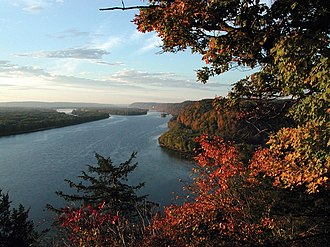
The word Mississippi comes from Misi zipi, the French rendering of the Anishinaabe name for the river, Misi-ziibi, meaning Great River.
Mississippi-Missouri
United States
The Mississippi River is the primary river of the largest drainage basin in the United States. It is the second-longest river in the United States, behind only the Missouri.
From the “Name and significance” section
Text from Wikipedia, CC BY-SA 4.0.
Photo: NPS photo · Public Domain

The Mackenzie River basin covers portions of five Canadian provinces and territories.
Mackenzie
Canada
The Mackenzie River is a river in the Canadian boreal forest and tundra. It forms, along with the Slave, Peace, and Finlay, the longest river system in Canada, the second largest drainage basin of any North American river after the Mississippi.
From the “Geography” section
Text from Wikipedia, CC BY-SA 4.0.
Photo: David Adamec · Public Domain

The river's name is derived from the Warao term for 'a place to paddle'.
Orinoco
Multiple
The Orinoco is one of the longest rivers in South America at 2,140 km (1,330 mi). Its drainage basin, sometimes known as the Orinoquia, covers approximately 1,000,000 km2 (390,000 sq mi), with 65% of it in Venezuela and 35% in Colombia.
From the “Etymology” section
Text from Wikipedia, CC BY-SA 4.0.
Photo: jkaiser · CC BY 2.0

The Lena originates at 1,640 meters (5,381 ft) of elevation in the Baikal Mountains.
Lena
Russia
The Lena is a river in the Russian Far East and is the easternmost river of the three great rivers of Siberia which flow into the Arctic Ocean, the others being Ob and Yenisey.
From the “Course” section
Text from Wikipedia, CC BY-SA 4.0.
Photo: No machine-readable author provided. Linjye assumed (based on copyright claims). · CC BY-SA 4.0

The name 'Irrawaddy' is derived from Pali, referring to the elephant mount of Sakka and Indra in Hinduism.
Irrawaddy
Myanmar
The Irrawaddy River is the principal river of Myanmar, running through the centre of the country. Myanmar's most important commercial waterway, it is about 1,350 mi (2,170 km) long.
From the “Names” section
Text from Wikipedia, CC BY-SA 4.0.
Photo: Bjørn Christian Tørrissen · CC BY-SA 3.0

The Sumerian term for the Tigris can be interpreted as 'the swift river'.
Tigris
Multiple
The Tigris is the eastern of the two great rivers that define Mesopotamia, the other being the Euphrates. The river flows south from the mountains of the Armenian Highlands through the Syrian and Arabian Deserts, before merging with the Euphrates and reaching to the Persian Gulf.
From the “Etymology” section
Text from Wikipedia, CC BY-SA 4.0.
Photo: Duha masood · CC BY-SA 4.0

The Colorado River begins in Rocky Mountain National Park.
Colorado River
Multiple
The Colorado River is one of the principal rivers in the Southwestern United States and in northern Mexico. The 1,450-mile-long (2,330 km) river, the 5th longest in the United States, drains an expansive, arid watershed that encompasses parts of seven U.S. states and two Mexican states.
From the “Course” section
Text from Wikipedia, CC BY-SA 4.0.
Photo: Charles Wang · CC BY-SA 4.0

The river Dnieper is also known by the Russian name Dnepr, where the initial D is generally silent in English pronunciation.
Dnieper
Multiple
The Dnieper or Dnepr, also known as the Dnipro, is one of the major transboundary rivers of Europe, rising in the Valdai Hills near Smolensk, Russia, before flowing through Belarus and Ukraine to the Black Sea.
From the “Names” section
Text from Wikipedia, CC BY-SA 4.0.
Photo: Dmitry A. Mottl · CC BY-SA 3.0
You have seen 189 facts
Keep exploring - or dive deeper into a place page.
Switch topic